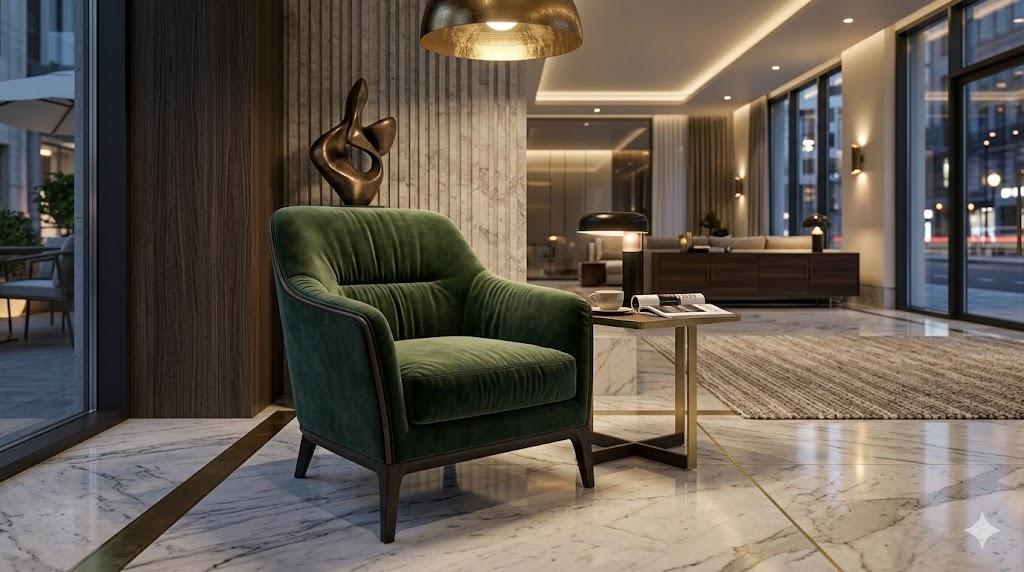
Hospitality interiors are increasingly favoring quieter forms, clearer proportions, and materials that reward close inspection. Italian design is one useful reference point, but a product's country of manufacture and its design influence are separate facts.
The Shift from Luxury Statement to Quiet Luxury in US Hospitality
The design language that defined luxury hospitality a decade ago — bold gold accents, oversized chandeliers, heavy dark woods — is losing relevance in new projects.
The next generation of hotel lobbies, restaurant lounges, and boutique hospitality spaces are leaning into quiet luxury: clean architectural lines with warm material depth, upholstery that invites long stays, craft-forward details in joinery and hardware.
These qualities are often associated with Italian modernism, but buyers should evaluate the actual silhouette, materials, construction, sample, and project documentation rather than relying on an origin label.
Design Influence Is Not Country of Manufacture
Italian-inspired seating can be developed and produced in different manufacturing regions. A clear supplier should state both the design direction and the production location without implying that an Italian-inspired product was made in Italy.
Robert CASA describes its collection as Italian-inspired design, manufactured and quality-controlled in Foshan, China. This distinction gives specifiers a more accurate basis for comparing design, price, customization, and production requirements.
What Project Buyers Should Verify
Start with the exact product rather than a general brand claim. Confirm dimensions, materials, finish samples, assembly, packaging, production timing, and the acceptance criteria that will appear in the order documents.
If a project requires abrasion, fire-performance, structural, or other test documentation, name the applicable standard and ask whether evidence is available for the selected material and configuration. Do not assume that a broad term such as contract grade proves a specific result.
How Italian-Inspired Design Shows Up
Look for disciplined proportions, legible structure, restrained material combinations, and details that support the overall silhouette. Those features can be evaluated in drawings, samples, and production photography without making unsupported claims about origin or heritage.
For project sourcing, the strongest evidence is specific and repeatable: an approved sample, a confirmed specification, documented quality-control checkpoints, and production that matches the signed order.
See these principles in the Italian-inspired armchair collection. Hotel and restaurant buyers can then review the separate hospitality seating process for project planning, samples, and quotation requirements.